
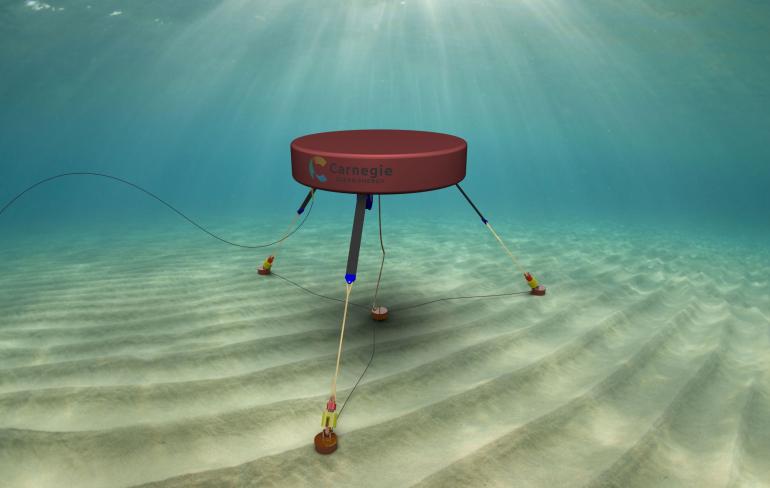
Tapping the power of oceans to create a new, sustainable source of clean energy is now big news globally, but Australia has been testing the waters for some time.
Tidal or wave energy is generated by converting the energy within ocean waves into electricity, an emerging sector now attracting the interest of governments, investors and startups.
Wave energy has a lot in its favour given its potential to provide consistent, baseload power, unlike solar and wind, which can stabilise energy grids and reduce the need for extensive energy storage.
There are three main types—wave, tidal and ocean thermal—which is why there is already over 200 different wave energy technologies being developed and trialled around the world. Many of them are happening here in Australia given its vast coastline with some of the world’s largest tides.
But so far wave energy has been too expensive, too difficult to install, and too disconnected from existing grids to make commercial sense. But as technologies advance those challenges are receding.
That possibility is fuelling wave energy optimism. For a start the International Energy Agency—which leads an Ocean Energy Systems program—expects roughly 87 TWh of ocean energy to be produced by 2050, while the European Union now has a goal of developing 1 GW of ocean energy capacity by 2030 and 40 GW by 2050.
In Australia, the national Renewable Energy Agency—ARENA—has now funded 14 innovative R&D and demonstration marine energy projects around the country since 2012. One of those was the design, construction, deployment, installation and operation of the UniWave200, a 200KW wave energy converter near Tasmania.
ARENA also partnered with the CSIRO on creating the Wave Atlas, a 4D interactive wave map of the greater Australian coastal area relative to available infrastructure. That study also found that wave energy could contribute up to 11% of Australia’s energy by 2025—enough to power a city the size of Melbourne.
The excitement over wave energy is exemplified by an Australian startup, Marine Energy Research Australia or MERA, which is currently testing a “novel wave energy converter” off the coast of West Australia. Their converter uses vibrating steel frames to drive the generators in the attached hinges to create electricity.
The MERA team also says theirs is “the first fully open-access, wave-energy project, where we will share the lessons learned and the data collected — as well as the power we generate — openly with everybody.”
Like all clean energy, copper is integral to its success and wave energy is no exception, a key component in electricity generators and the cabling needed to connect offshore projects with homes and businesses onshore.